

Why corrosion protection deserves more attention
For manufacturers shipping metal components, corrosion can become an expensive problem long before a product reaches its final destination.
This is especially important for components transported by sea or air freight or placed into long-term storage. Changes in temperature and humidity can create condensation inside packaging, exposing metal surfaces to moisture and increasing the risk of corrosion.
The consequences can be significant. A corroded component may need to be repaired, reworked or replaced, potentially causing production delays, supply-chain disruption and additional costs for customers.
This is particularly important in industries such as automotive, aerospace, engineering, machinery and industrial manufacturing, where components can be high value and even minor corrosion can affect performance, appearance or usability.
The good news is that effective corrosion protection does not have to be complicated. The key is understanding the conditions a product will experience and selecting the right combination of moisture-control, VCI and packaging materials for the application.
1. Understand what you are trying to protect
There is no universal corrosion-protection solution.
Before selecting a desiccant or other protective material, manufacturers should consider:
- The type of metal being protected
- Component size and weight
- Surface finish and sensitivity
- Packaging dimensions
- Expected storage duration
- Transportation method
- Temperature and humidity conditions
- Whether the packaging will be opened during transit
- The required level of protection
A component transported by sea across different climates will face very different conditions from one stored for several weeks in a controlled warehouse.
Understanding the purpose of the packaging is therefore the first step.
It helps determine the appropriate protection method and quantity while reducing the risk of either under-protecting the product or using more packaging material than necessary.
2. Calculate the right amount of moisture protection
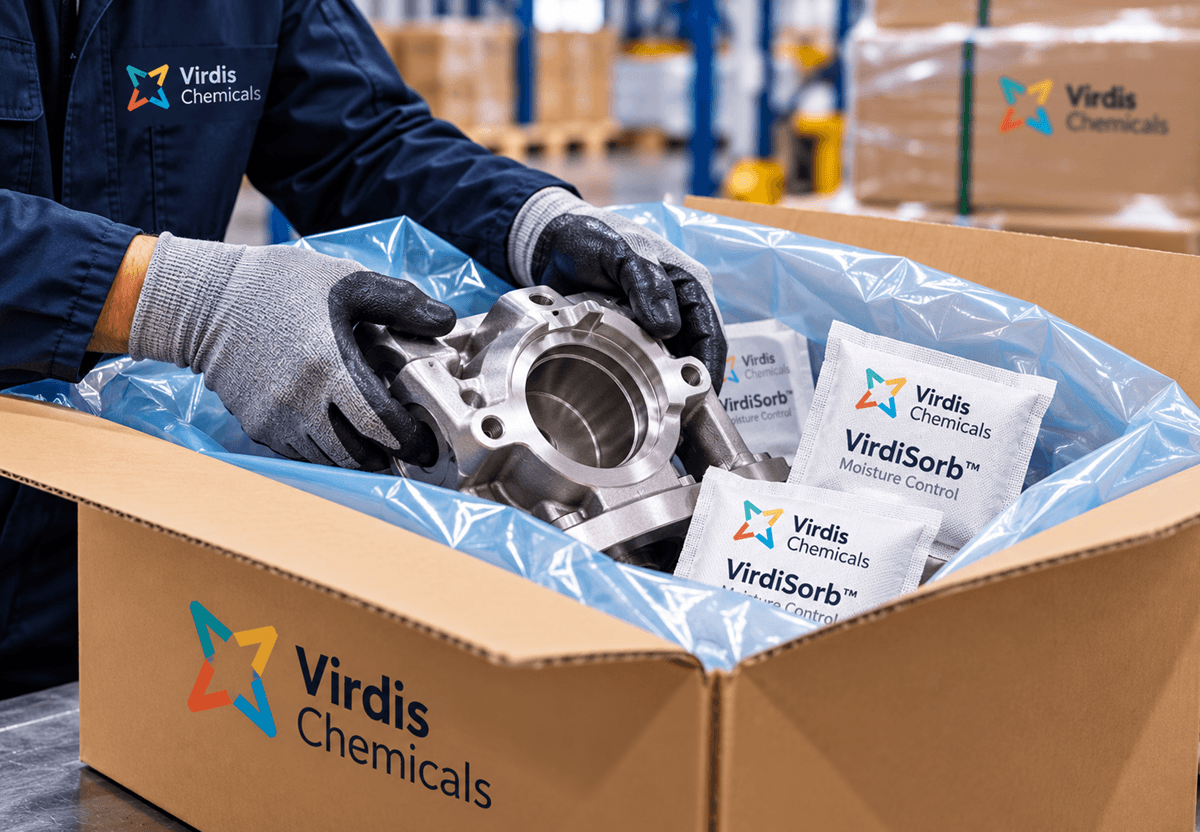
One common mistake is assuming that more desiccant automatically means better protection.
In reality, the required quantity depends on the specific application. Factors such as packaging volume, the materials inside the packaging, storage duration, environmental conditions and the expected moisture load all need to be considered.
Using a standard number of desiccant units based purely on historical practice may not provide the most efficient solution.
A packaging or moisture-control specialist can help calculate the appropriate amount for the application.
Getting the calculation right can provide reliable moisture protection while helping manufacturers control material costs and avoid unnecessary packaging.
3. Choose the right desiccant or VCI solution
Desiccants and VCI (Volatile Corrosion Inhibitor) products work in different ways.
Desiccants help control moisture within a sealed packaging environment by absorbing water vapour. VCI products, meanwhile, protect metal surfaces through corrosion-inhibiting vapours that form a protective layer around the component.
Depending on the application, either technology may be suitable, or they may be used together as part of a broader corrosion-protection system.
Traditional desiccant options include materials such as silica gel and clay, while newer moisture-control technologies provide additional options for manufacturers looking to improve performance, sustainability or packaging efficiency.
VirdiSorb™: an alternative approach to moisture control
VirdiSorb™ is a hyperdesiccant designed to provide high-performance moisture control and can be considered as an alternative to conventional moisture-control materials such as silica gel, calcium chloride and clay desiccants.
For manufacturers looking beyond traditional materials, VirdiSorb™ can provide another option when designing a moisture-control system for metal components, industrial products and other moisture-sensitive goods.
VirdiSorb™ is also available in a biodegradable formulation, designed with sustainability in mind. The biodegradable version uses natural materials and a paper wrapper lined with plant-based PLA, without microplastics.
Selecting the right material should ultimately be based on the specific application, required performance, packaging design and environmental objectives.
4. Look at the whole process, not just the packaging
Sometimes corrosion appears to be a packaging failure when the real cause is elsewhere in the process.
For example, metal components can develop stains or corrosion because of contamination introduced during handling. Fingerprints, oils, chemicals or other contaminants transferred to a metal surface before packaging can contribute to corrosion problems.
This means that simply adding more desiccant may not solve the underlying problem.
Manufacturers should examine the complete process, including:
- Component manufacturing
- Cleaning and surface preparation
- Handling procedures
- Gloves and protective equipment
- Packaging materials
- Sealing methods
- Storage conditions
- Transportation
- Final unpacking
The interaction between different protection methods should also be considered.
For example, a component may be protected with grease or oil before being packaged with desiccant. Depending on the application, the moisture-control material and protective coating may interact in ways that affect the overall system.
A successful corrosion-protection strategy therefore needs to consider the entire packaging and handling process, rather than treating the desiccant as a standalone product.
5. Consider changing supply-chain conditions
The conditions a product experiences during transport should always influence the packaging specification.
Temperature and humidity are particularly important.
During international transportation, products may experience significant changes in environmental conditions. A shipment can move between hot, humid climates, refrigerated or temperature-controlled environments and dry warehouse conditions.
These changes can increase the risk of condensation inside packaging.
Sea freight can be particularly challenging because shipments may spend weeks in variable environmental conditions. Long-term storage can create similar challenges if temperature and humidity are not adequately controlled.
Air freight also presents its own considerations. Packaging may be opened during security inspections or customs checks, potentially exposing moisture-control materials to the surrounding atmosphere.
The packaging system should therefore be designed with the complete supply chain in mind.
Don’t overlook the packaging combination
Desiccants and VCI products are only part of an effective corrosion-protection strategy.
The packaging environment itself is equally important.
Depending on the application, effective protection may involve a combination of:
- Moisture-control desiccants
- VCI packaging
- Barrier films
- Protective bags
- Sealed packaging
- Boxes or crates
- Protective coatings
- Appropriate handling procedures
The objective is to create an environment that limits the factors responsible for corrosion.
In some applications, changing the packaging approach may also reduce or eliminate the need for traditional grease or oil-based protection. This can potentially reduce labour requirements, simplify packing operations and make components easier to handle when they reach the customer.
The most appropriate combination depends on the product, environment, transportation method and required storage period.
Don’t forget about desiccant storage
Even the right desiccant will not perform as intended if it is improperly stored before use.
Many moisture-absorbing materials begin interacting with atmospheric moisture as soon as they are exposed to the surrounding environment.
Manufacturers should therefore follow the supplier’s storage and handling recommendations and keep moisture-control products properly sealed until they are required.
Good storage practices help ensure that the desiccant retains its intended moisture-absorption capacity when it is finally placed inside the packaging.
The takeaway: there is no one-size-fits-all corrosion solution
Effective corrosion prevention starts with understanding the product’s complete journey — from manufacturing and handling through packaging, storage, transportation and final delivery.
The five key considerations are:
- Understand the product and why corrosion protection is required.
- Calculate the appropriate level of moisture protection.
- Select the right desiccant, VCI or combination of technologies.
- Examine the complete handling and packaging process.
- Review the solution as products, technology and supply chains change.
Technology continues to develop, and manufacturers should not assume that a packaging process used for many years is necessarily the most efficient option today.
A process based on oil or grease and traditional packaging may still be appropriate for certain applications. However, modern desiccant, VCI and barrier-packaging technologies can provide alternative approaches that may help improve protection, simplify handling and reduce packaging labour.
For manufacturers experiencing recurring corrosion problems, the best starting point is not necessarily adding more protective material.
Instead, review the complete packaging system.
Where is moisture entering the packaging? How much moisture protection is actually required? Are the components being contaminated during handling? Is the packaging properly sealed? Could a different combination of moisture-control and corrosion-protection technologies provide a more suitable solution?
How Virdis Chemicals can help
At Virdis Chemicals, we understand that moisture control is not simply about placing a desiccant inside a box.
The right solution depends on the product, packaging environment, transportation conditions, storage period and required level of protection.
Our moisture-control technologies, including VirdiSorb™, are designed to help manufacturers address moisture-related challenges across a range of industrial applications.
Whether you are looking for an alternative to conventional desiccants, exploring biodegradable moisture-control options or reviewing your existing corrosion-protection process, the first step is understanding the specific requirements of your application.
The goal is not simply to use more protective material. It is to use the right protection, in the right quantity, within the right packaging system.
If your business is experiencing corrosion, condensation or moisture-related damage during storage or transportation, Virdis Chemicals can help you evaluate your moisture-control requirements and identify an appropriate solution.
Explore our VirdiSorb™ moisture-control solutions to learn more about how advanced moisture management can support safer and more efficient packaging.
Related solutions:
- VirdiSorb™ Biodegradable Moisture Control
- Cargo Moisture Control
- Industrial Moisture-Control Solutions